
Legacy ECU code in. ASPICE-ready design documents out.
A fault-tolerant C/C++ parser: no build system, no compiler.
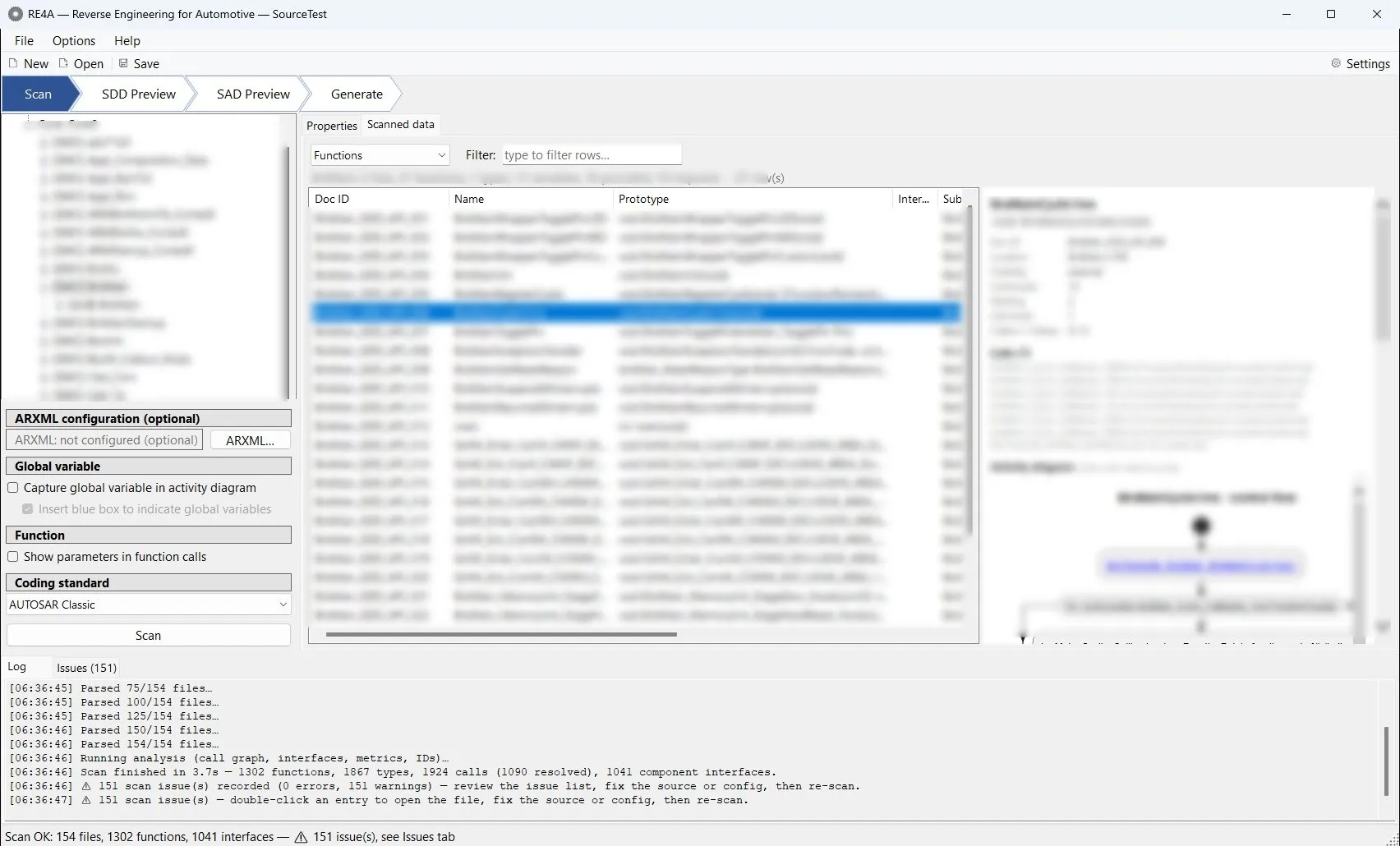
One run on the bundled demo project
- 154
C files scanned
- 1,302
functions documented
- 1,867
types
- 1,041
component interfaces
- 389
exact design↔code trace links
- 1,757
diagrams generated
- 3.7
seconds — scan and static analysis
3.7 s covers scan and static analysis only — not document generation, diagram rendering or engineer review.
The problem
The code shipped. The design documents didn’t.
ASPICE demands evidence
SWE.2 and SWE.3 require architecture and detailed design.
Manual documentation doesn’t scale
Stale after the next merge.
Legacy code won’t even build
Compiler-based tools stop there.
How it works
Four steps from source to documents.
Group
Proposes a component tree from your folders.
Scan
Reads C/C++ without compiling it.
Analyze
Call graph, interfaces, metrics and deterministic IDs.
Generate
SAD, SDD, diagrams and the trace matrix.
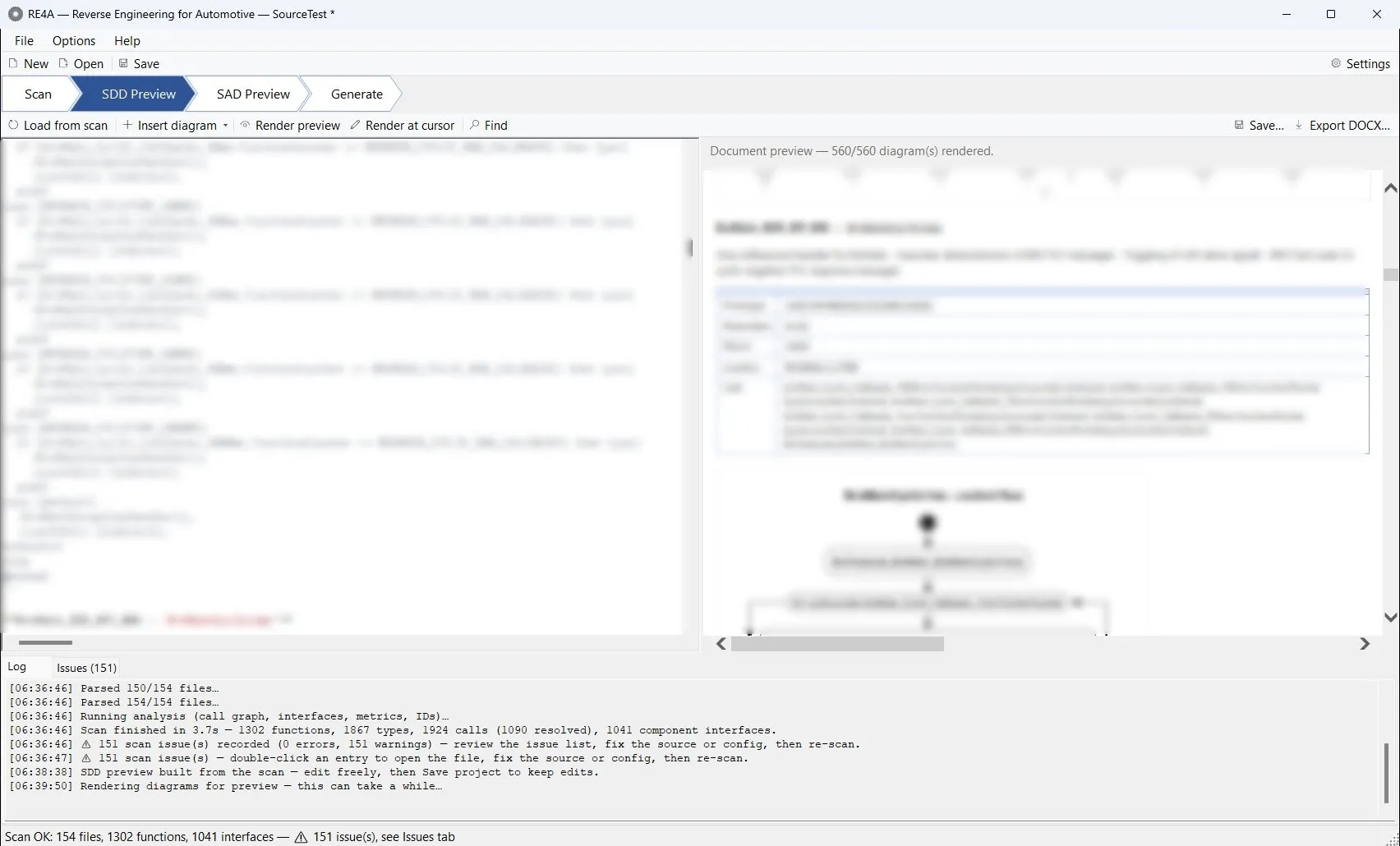
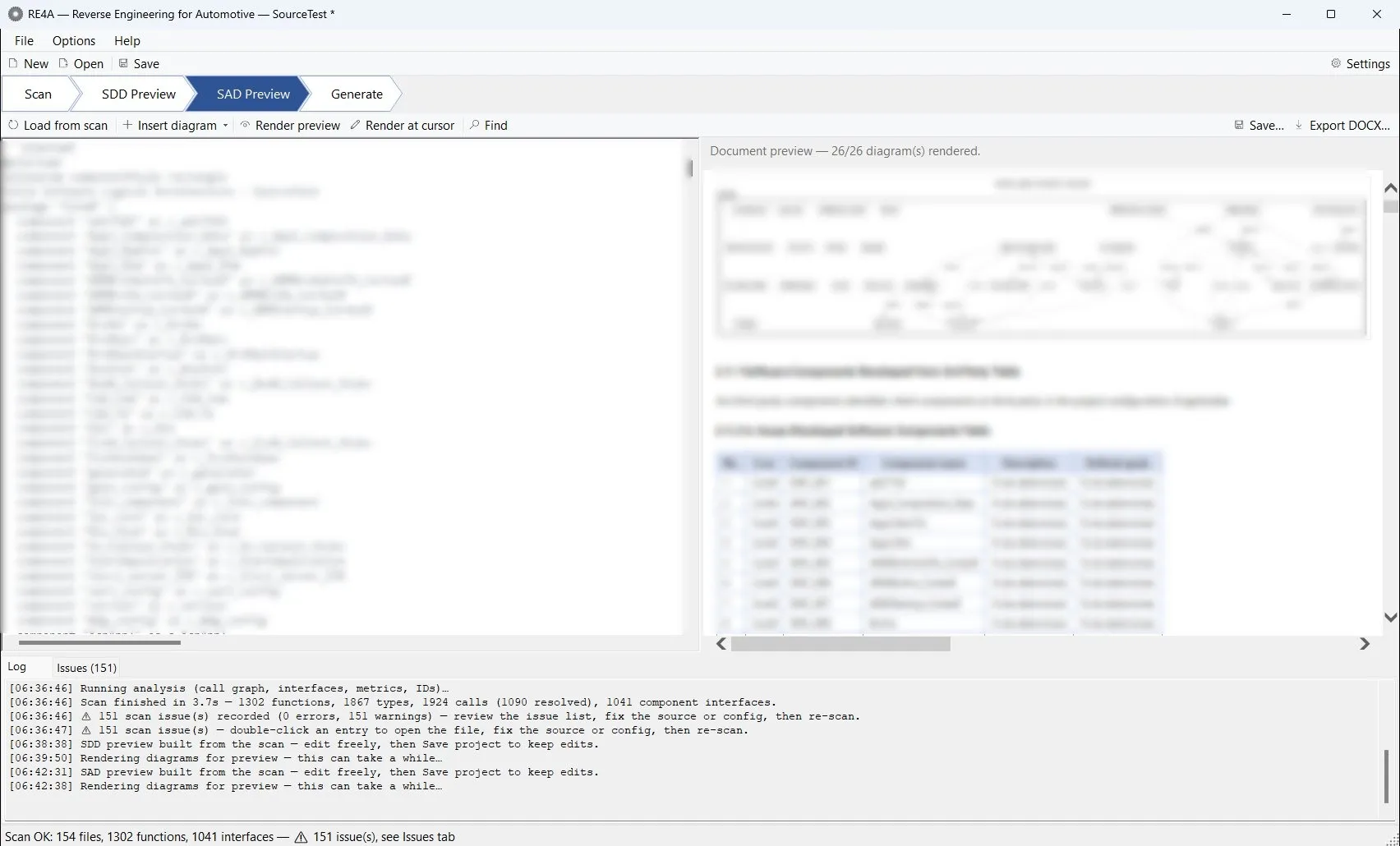
Product tour
From scan to document — inside the tool.
The parser
It reads the code the compiler refuses.
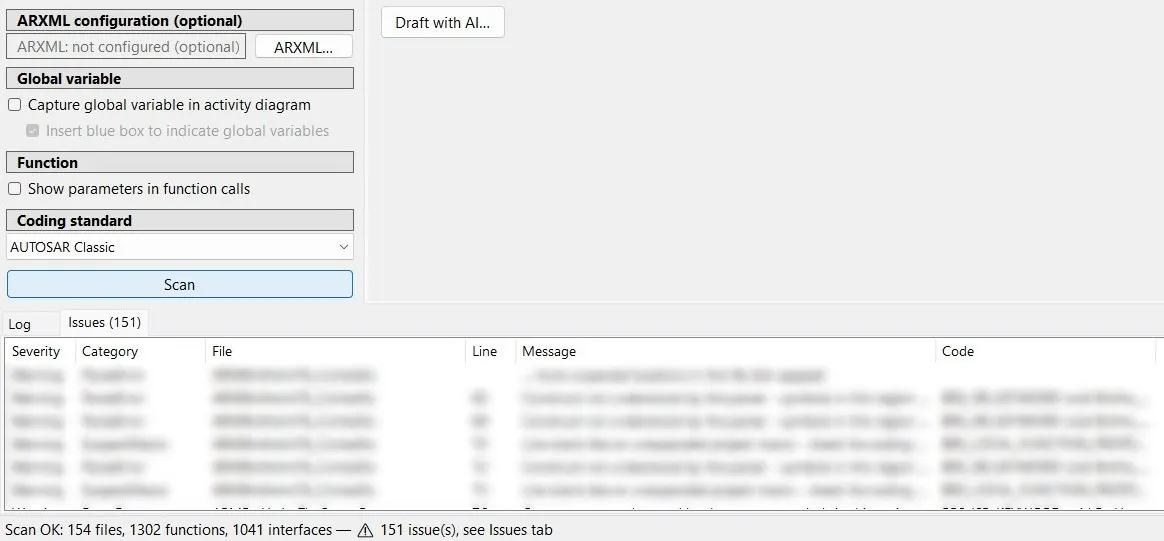
The issue log from that run
0errors
151warnings
Each carries its file, line, offending code and a fix hint. No silent guessing.
What you get
Seven outputs from one run.
Native Open XML Word output — no Office automation.
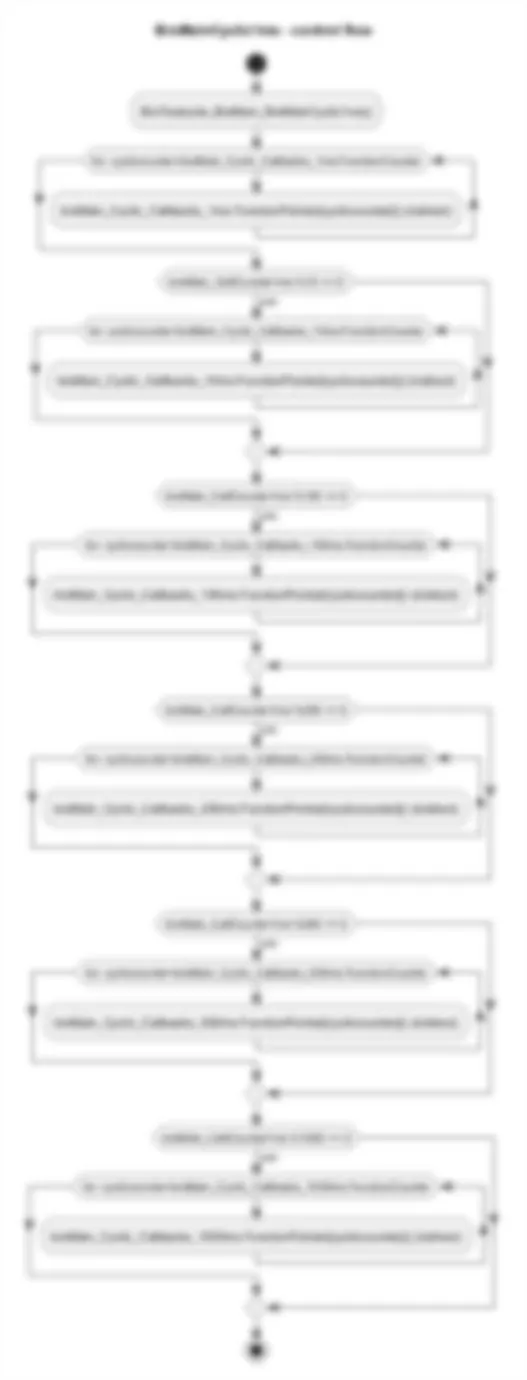
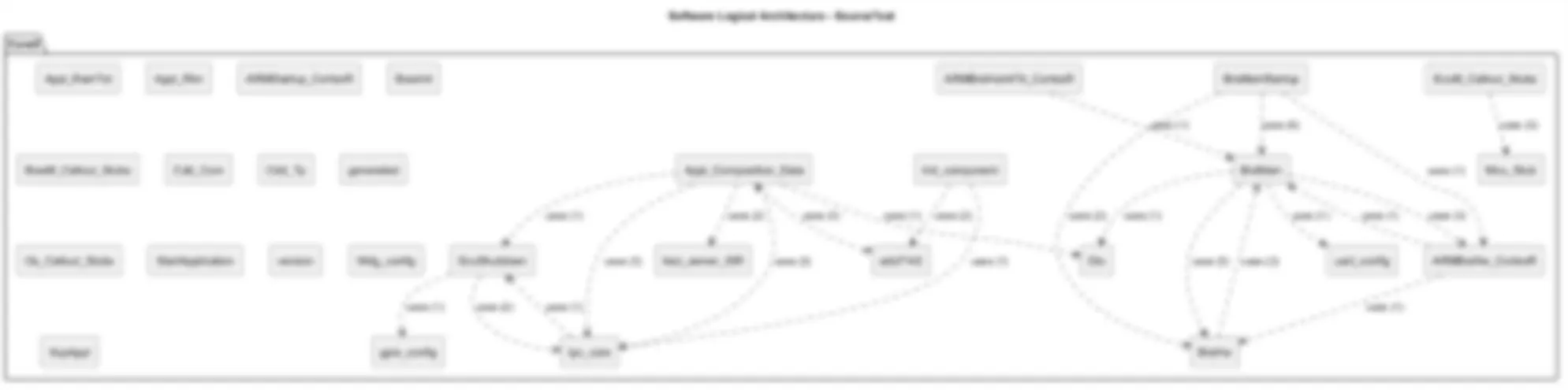
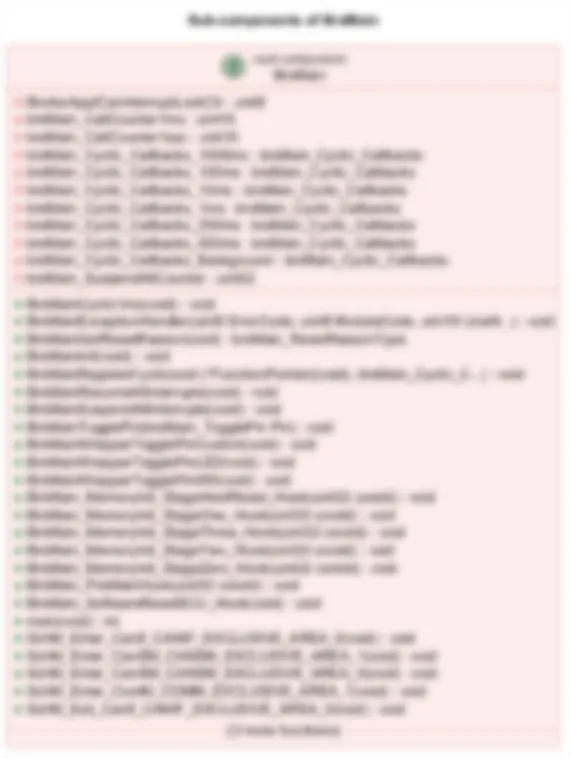
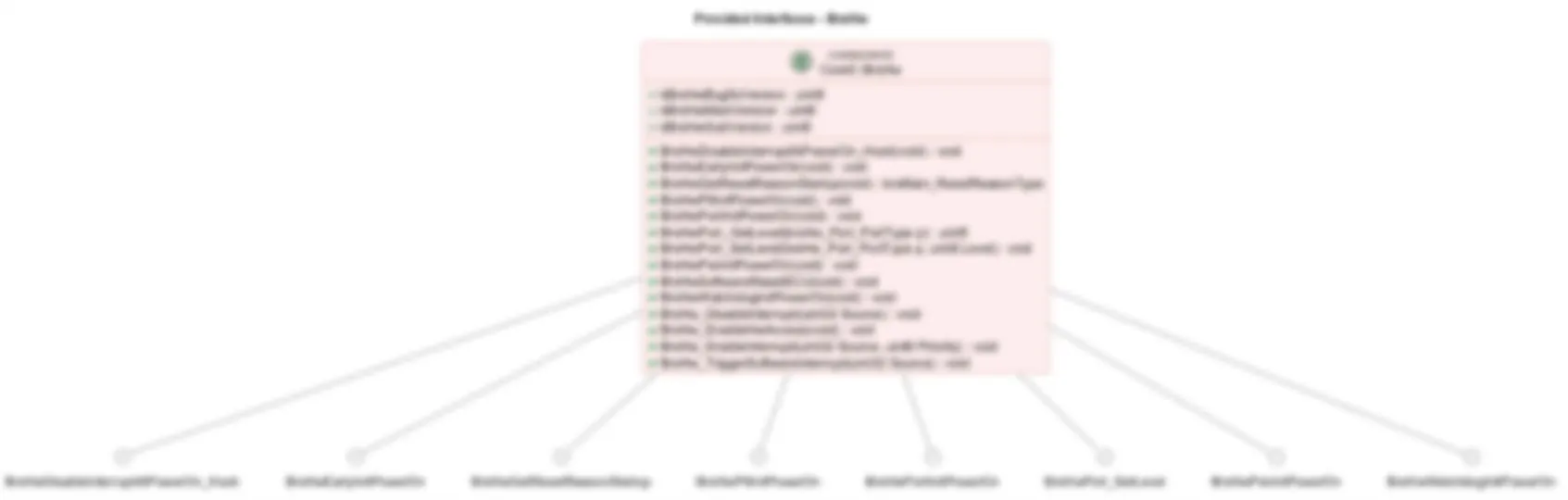
- SAD.md / .docx
- SDD.md / .docx
- traceability.csv / .md / .docx
- diagrams/**.puml + .png
- metrics.csv
- issues.csv
- model.xml
Traceability
Design traced to code — to the file and line, both ways.
| Design element | Kind | Source file | Line | Counterpart | Direction | Status |
|---|---|---|---|---|---|---|
| HwCore_IF_001 | SAD interface · provided | HwCore.c | 139 | HwCore_SDD_API_001 | design to code | Exact |
| HwCore_SDD_API_001 | SDD API | HwCore.c | 139 | HwCore_IF_001 | code to design | Exact |
| HwCore_IF_002 | SAD interface · provided | HwCore.c | 164 | HwCore_SDD_API_002 | design to code | Exact |
| HwCore_SDD_API_002 | SDD API | HwCore.c | 164 | HwCore_IF_002 | code to design | Exact |
| StartupMain_IF_001 | SAD interface · required | StartupMain.c | 963 | StartupMain_SDD_API_008 | design to code | Exact |
| StartupMain_SDD_API_008 | SDD API | StartupMain.c | 963 | StartupMain_IF_001 | code to design | Exact |
Integrations
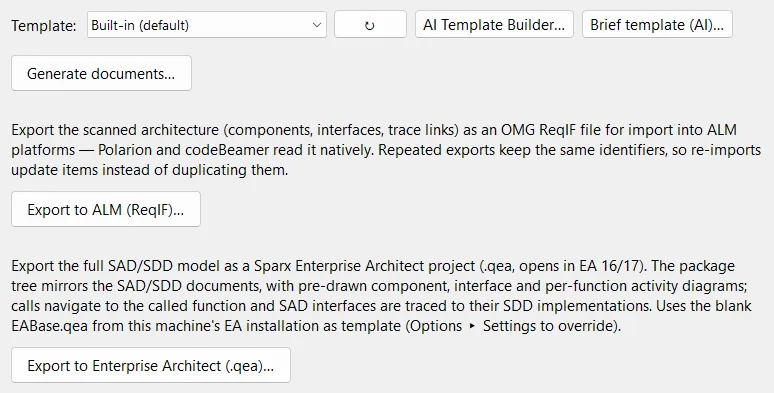
Exports to Word, Enterprise Architect and ReqIF.
Stable IDs
Unchanged elements keep their IDs across runs.
A command-line interface
The same run, from the command line.
Exports
Diagrams also ship as editable PlantUML source.
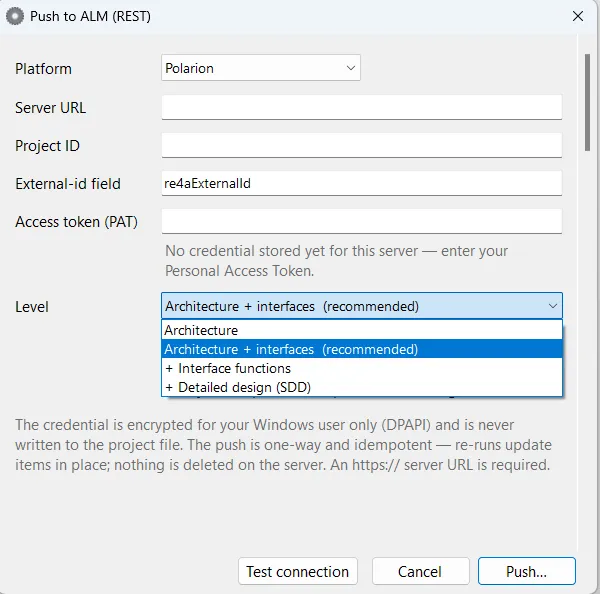
Push to Polarion or codeBeamer
One-way and idempotent: re-runs never delete.
Polarion · codeBeamer — one-way push
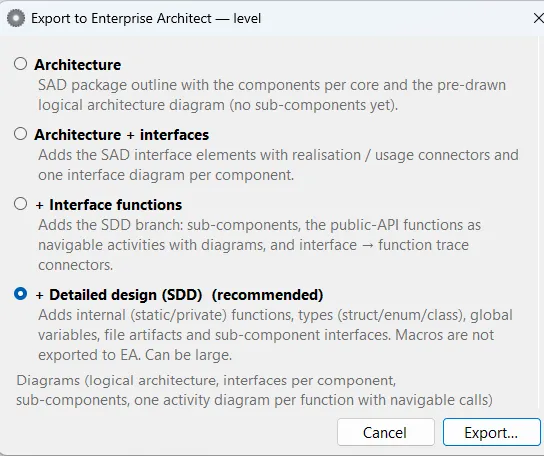
AI-assist
Let AI draft the prose. Opt-in, and off by default.
0 bytes of source code leave the machine in the default configuration.
What this page does not claim
- Traceability is design↔code, to the file and line — not requirement-to-test traceability.
- 3.7 s is scan and static analysis only, never an end-to-end time.
- Figures come from one 154-file demo project on a laptop.
- Judgement calls are marked To be determined.
Evaluate it
Bring a legacy source tree — even one that won’t build.
We scan it with you and walk through the output.